
White Plains Resident Lookup Record Coverage
No official local system combines every kind of White Plains record. City assessment material identifies the owner as assessed, a tax mailing line, and parcel details. A County Clerk deed identifies the people named on a recorded transfer. Court services index selected public cases, while vital-record applications document an event only when eligibility rules are met. The useful result is a narrow confirmation, not a claim that every person connected with a property appears in one system.
| Record | What It Confirms | Where | Access |
|---|---|---|---|
| Assessment roll or tax account | Assessed owner, mailing line, parcel and deed clue | White Plains Assessor and tax inquiry | City roll and public tax search |
| Recorded land instrument | Grantor, grantee, legal description, recording trail | Westchester Records Online or County Clerk | Index, terminal, account, or copy route |
| Court index | Displayed party, court, case number, and status details | NYS eCourts and City Court | Service and case coverage vary |
| Voter service | A voter’s own status or poll-site information | NYS voter lookup | Identity fields and election-purpose limits |
| Vital event | Eligible birth, death, marriage, or genealogy copy | White Plains City Clerk or NYS DOH | Restricted application process |
| Estate reference | Decedent, proceeding type, year, and archive lead | Westchester Surrogate index | Index is not the complete file |
For a current property question, begin with the assessment record and then compare a deed’s date and legal description. For a historic family question, begin with a known decedent or event date, not a speculative current address. The City and County offices are both in White Plains, but they keep different records and serve different jurisdictions.
Note: A mailing address on an assessment roll may differ from the physical parcel address and does not establish who occupies the property.
White Plains Court Records Need Context
White Plains City Court links its Local Civil and WebCrims routes, while statewide eCourts separates WebCivil Local, WebCivil Supreme, WebCriminal, WebFamily, NYSCEF, and eTrack. Select the court and case family before treating a name result as meaningful. An online absence is also limited evidence: sealed matters, certain Article 81 cases, youthful-offender records, adoptions, cases not yet recorded, and cases without a future appearance may not display.
The public screen is an index route, not a complete case file. A City Court or County Court clerk controls the file, and the court that entered information handles corrections. For an in-person research channel, the Westchester Supreme Court Law Library has public computers, a Civil City Court Records Search terminal, and an e-file terminal. This local terminal is useful when the web result is incomplete, but it does not make confidential material available.
| Displayed court-result field | Why it matters |
|---|---|
| Party name and role | Distinguishes a named party from another relationship to the case. |
| Case, index, or docket number | Gives the clerk a concrete retrieval reference. |
| Court and case type | Shows which court created the entry and its scope. |
| Status or next appearance | May be displayed for applicable current matters and can change. |
| Filed, incident, or appearance dates | Places the result in time before it is compared with another record. |
| Judge, attorney, or authorized document links | May appear when the selected service and filing permit it. |
Note: Give a clerk the court, parties, approximate date, exact record requested, and case number when one is known.
White Plains Court Records at the Terminal
White Plains is the Westchester County seat, so a court or County office may carry a White Plains address while serving a wider area. That distinction matters when comparing a name result with a city event or parcel. The law library’s public terminal and its copy rules provide a practical third route between an online index and a formal file request. Copies are listed at $0.25 per page, while printing is permission-limited and free up to 20 pages per day under the library’s stated conditions.
For a court correction, contact the court that entered the data instead of asking a different public office to alter it. Court records are requested under court-access rules, not through a routine City FOIL request. This is a useful comparison: the web screen locates a record, while the court or clerk decides what file material can be inspected, copied, or certified.
Verify a White Plains Resident Lookup in Steps
Use at least two independent record types before accepting a same-name match. The sequence below is designed for an owner or recorded-party question. It does not turn a property record into a list of people at an address, and it avoids treating a court or voter result as a current-address statement.
- Find the assessed parcel through the City tax material and write down the situs address, mailing line, SBL or parcel identifier, and any deed book or page clue.
- Use the parcel details to locate the recorded instrument through WRO, a County Clerk terminal, or the Land Records Division. Compare its legal description and recording date with the assessment clue.
- Search a court service only for the court question at hand, using the full name and a known case number where possible. Keep the court and date beside the result.
- For an estate trail, search the decedent’s name in the Surrogate index and use its year, county, record type, and archival reference to request the correct material.
- Ask the custodian for a copy or correction only after the record number, office, and time period are clear.
- Docket
- A docket is the court’s running case record or number used to track filings and events.
- Index versus image
- An index points to a record through names, dates, or numbers. An image is a view of the document itself and may have different access rules.
- Certified copy
- A certified copy is issued by the custodian with its official certification. It is different from an unofficial printout or a search-screen result.
For a street-wide address trail rather than one identified person or record, use the White Plains streets directory workflow. It is built around parcels and recorded instruments along a named street.
Westchester Estate Leads for Name Verification
The Westchester Surrogate’s Court index is a focused route for estate and heir research. It accepts a partial surname, first name, and year search, then returns a decedent, year, county, record type, and archival reference. Start with a known deceased person and a likely time period. An estate reference can lead to a proceeding or later file request, but it is not a live-person finder and the index does not replace the underlying file.
Older county research may need the Westchester County Archives. Its documented estate index range is 1782–1909, and its deed grantor/grantee research reaches 1680–1907. An estate name, year, and reference are better request details than a broad request for everyone connected to an address.
White Plains Vital Events Have Strict Access
The City Clerk is the local registrar only for births and deaths that occurred within White Plains city limits and marriage licenses issued in the City. Certificates are not an open name-search tool. Eligible applicants use the City’s forms, and the type of certificate controls who may request it. The City lists same-day walk-in service, without an appointment, from 9:00 a.m. to 3:30 p.m.; mail processing is stated as three to five days. A certified City copy is $10, while a qualifying genealogy copy is $22.
The White Plains vital-records page shows the local eligibility and application routes.
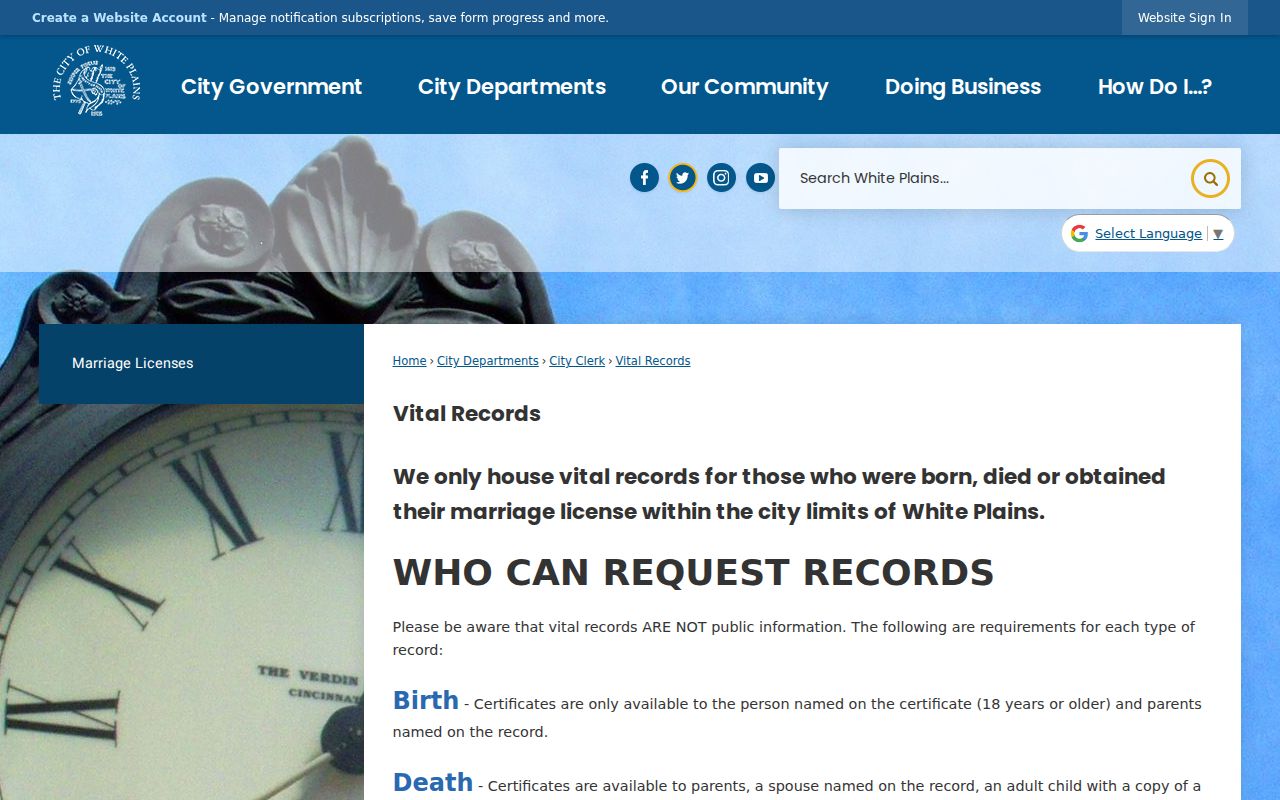
The City page is a reminder to identify the event location before applying. A White Plains mailing address alone does not prove that a birth, death, or marriage-license event belongs in the City’s registry.
For genealogy requests, the City follows the historic 75/50/50 tests: a birth record must be at least 75 years old and the named person known deceased; a death record must be at least 50 years old; and a marriage record must be at least 50 years old with both spouses known deceased. Direct descendants may qualify for a waiver with supporting proof. Confidential birth files remain unavailable.
New York State Vital Records Add a Backup
The NYS Department of Health keeps the statewide registry for events outside New York City, including White Plains events within its jurisdiction. A regular certified mail request is listed at $30 per copy with 10–12 weeks of handling time. The mail route requires one valid photo ID or two documents showing name and address, and payment is by check or money order. For historic work, use the state genealogy service rather than a regular certificate application.
The NYS DOH mail-application guidance identifies the state forms, identification choices, payment method, and handling estimate.
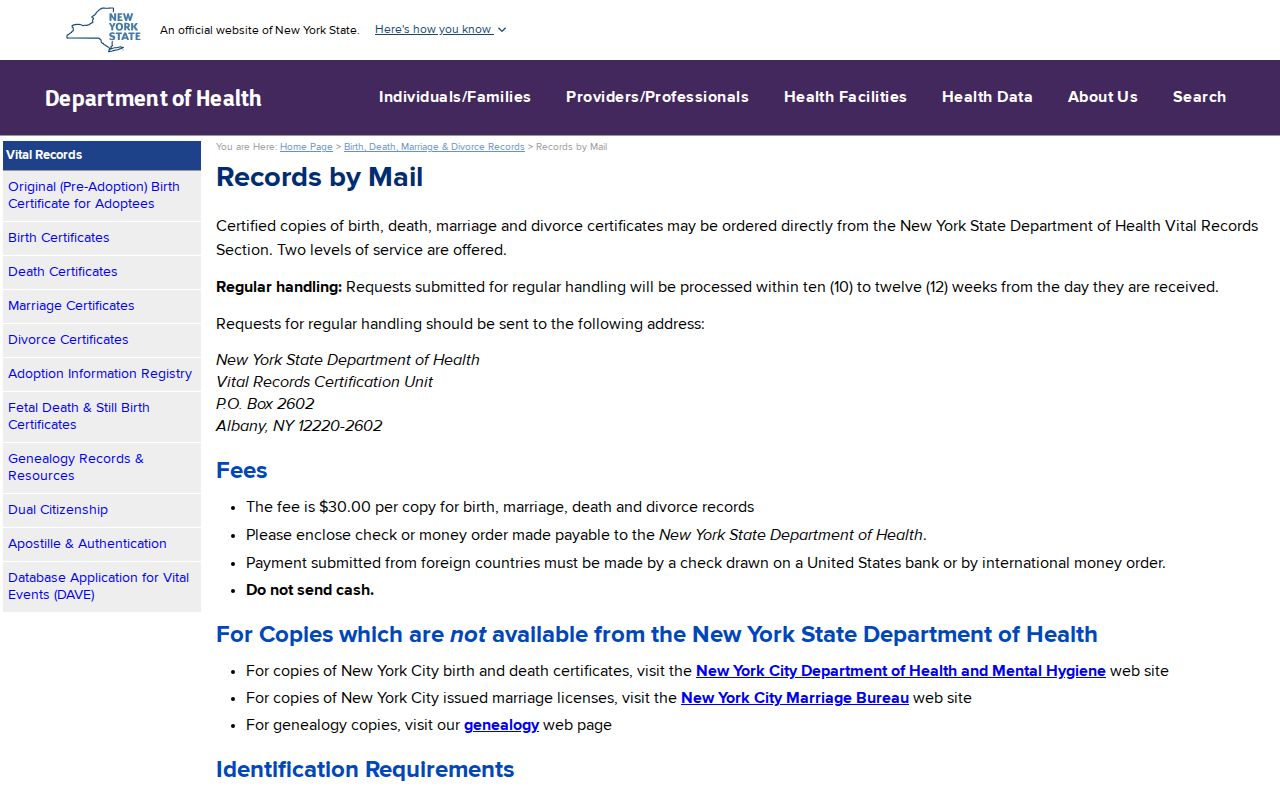
State genealogy copies follow the same 75/50/50 historic thresholds, but state search fees vary by the span searched and may take eight months or more. The state is a fallback for a qualifying historic event, not a way to browse living people.
White Plains Voter Status Is a Personal Check
The NYS voter service is designed for a registered voter’s own poll-site, registration, and ballot information. It asks for county, last name, first name, date of birth, and ZIP, with Westchester selected for a White Plains voter. It does not provide a public browse-by-name or browse-by-street directory. Election Law §3-103(5) restricts information derived from voter registration records to an elections purpose.
The Westchester Board of Elections can receive a defined authorized records request, but that is not a substitute for the self-lookup. A confidential voter record may be segregated from public inspection for four years and renewed. Treat a missing or substitute address as a privacy boundary, not a research problem to solve.
White Plains Resident Record Matches Need Checks
Similar names create the most common error. Keep the exact spelling shown by each custodian, a date, the record number, and the office that produced the result. Compare a deed’s legal description to the City parcel record rather than merging two entries because the names happen to match. A City assessment line, court index, and estate reference can each be accurate while describing different people or different times.
Business entity and professional-license services may confirm a public role, but a business, service-of-process, or practice address is not proof of residence. New York FOIL provides access to existing agency records subject to exemptions. It does not require an office to create a list, disclose protected vital material, or amend a deed, court case, or voter record. Ask the original custodian about its correction or amendment procedure.
Note: Record the source date and access method with any result because online indexes and assessment rolls change at different times.
White Plains Records Have Privacy Limits
New York’s Address Confidentiality Program can provide a substitute address for qualifying survivors of domestic violence, sexual assault, stalking, trafficking, and certain reproductive-health related applicants. Confidential-voter registration is a separate protection. Vital-record statutes restrict certificates, and court records can be sealed or redacted. Those limits exist even when a different record offers a partial name or property clue.
If a record is wrong, start with the office that created it. A court correction belongs with the court that entered the data, while an assessment, deed, certificate, or voter issue has its own custodian and procedure. Do not publish IDs, full dates of birth, or a protected address while seeking a correction.
Lawful use. Use White Plains records for a legitimate personal, family-history, estate, civic, or safety purpose. Do not use a record trail to stalk, harass, intimidate, or pursue a person whose information is protected or omitted.